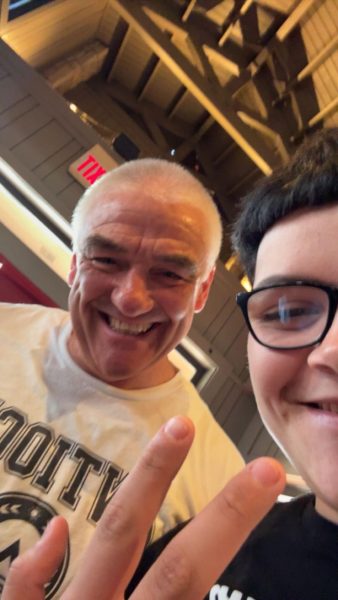
The classroom feels familiar—students talking before the bell, some ready to learn and others still half-asleep, and a teacher at the front trying to pull everyone in. It’s a scene that feels specific to today, shaped by phones and new technology, but for Ed Timm, high school history teacher, it’s almost exactly the same as it’s always been. After 40 years in education, including 20 at Mount Vernon High School, he says the biggest surprise is how little has actually changed.
“It’s like 95 percent of things haven’t changed,” Timm said. “Everybody says kids are different, but it’s really the same problems and challenges with a different cover on it.” According to Timm, the basic dynamic of school has stayed consistent for decades. Teachers are still trying to get students to work hard and learn, and students are still not always interested in doing that. “If kids could come to school and just do nothing, they’d celebrate,” Timm said. “That’s the game you play as a teacher—figuring out how to get them to learn anyway and keeping them engaged.”
Timm didn’t always teach high school. He started his career in 1986 at the college level, where he taught science-based classes like anatomy, biomechanics, and exercise physiology at Cornell. “Biomechanics is like physics applied to the human body,” he said. “I taught anatomy too—bones, systems, all of that.” His background came from his master’s degree, and at the time, that’s what the college needed him to teach. Even though he enjoyed those subjects, something about them didn’t stick with him the same way.
“I liked teaching anatomy, but I really like the human side of things more,” Timm said. That interest eventually led him to switch to history and government when he moved to high school teaching. For him, those subjects felt more meaningful because they connected directly to students’ lives. “I love teaching American government,” Timm said. “If we can get kids to vote and be involved, I think the world would be a better place.”
Even as education has added more technology and changed grading systems, Timm doesn’t think those changes matter as much as people believe. One major shift he experienced was the move to Evidence Based Reporting, but he still sees grades in a simple way. “A grade is just a way to motivate kids,” Timm said. “Most of what you learn doesn’t have anything to do with your grade.” Instead, he believes students take away lessons about effort, resilience, and who they are as people. “You’re not going to remember how you did on a test,” he said. “But you remember learning something about yourself, like that you can do hard things.”
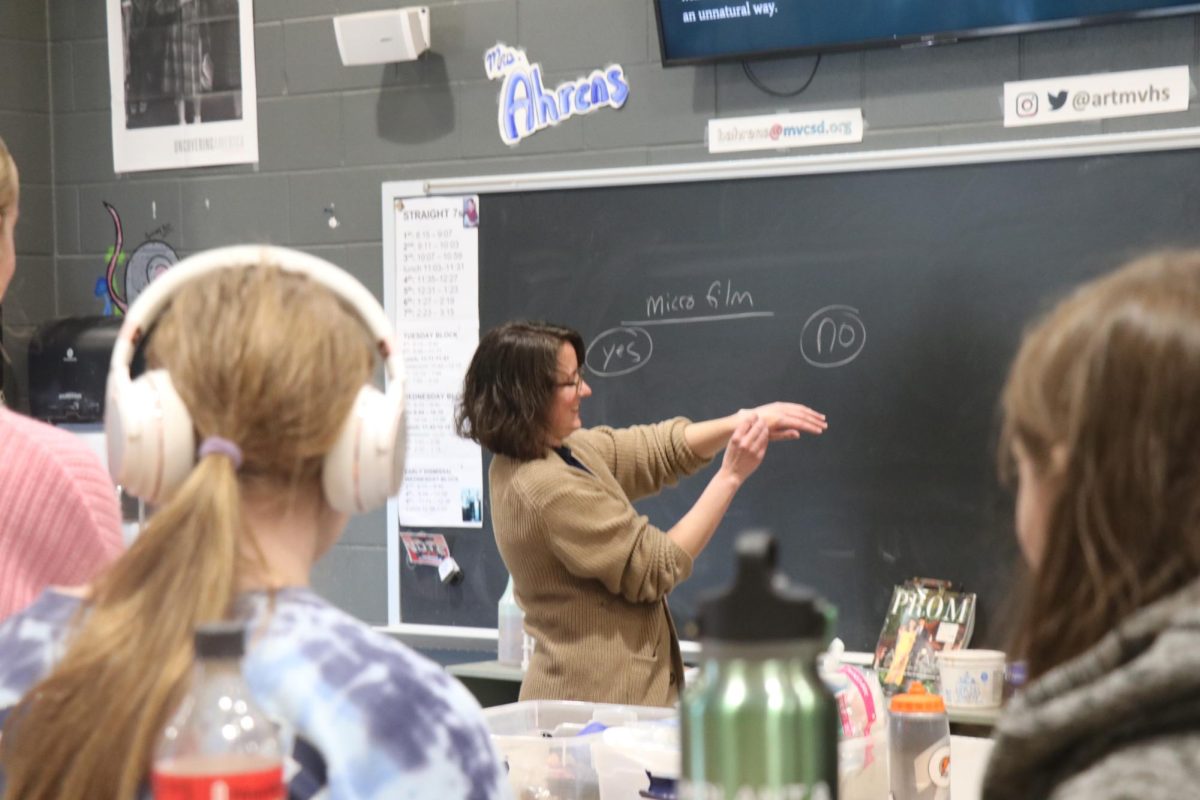
That belief shows up in how he teaches every day. Rather than relying heavily on slides or notes, Timm uses storytelling to connect with students and keep them engaged. “I teach in narrative. I tell stories,” he said. “It helps kids remember and keeps them interested.” He says he only really has two skills—telling stories and being sarcastic—but he’s used both throughout his career to reach students. He was inspired by his own teachers, who used similar methods. “The best teachers I had told stories,” Timm said. “That’s part of why I became a teacher—I wanted to be like that for other people.”
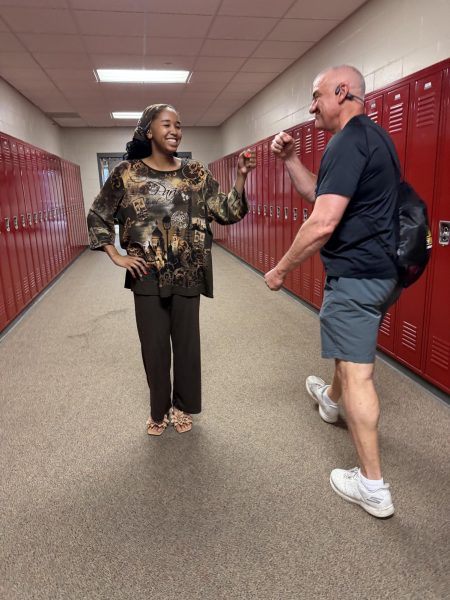
Students notice that difference in his classroom. Many say he’s one of the only teachers who can teach an entire lesson without looking at notes or a computer, making his class feel more natural and engaging. Others mention how his sarcastic humor keeps things interesting, even during long lectures. One of the most memorable parts of his class, though, is his spray bottle—something students quickly learn to expect. Whether used as a joke or to get someone’s attention, it became a small but unforgettable part of his teaching style. Between the spray bottle, his jokes, and his ability to lecture, students Teddy Bonewald, and Jackson Koehn say his class is one they won’t forget. Bonewald says one thing he likes about his class is “how it different than other classes. He’s able to lead a sports class and knows so much about it. His class was different and entertaining.”
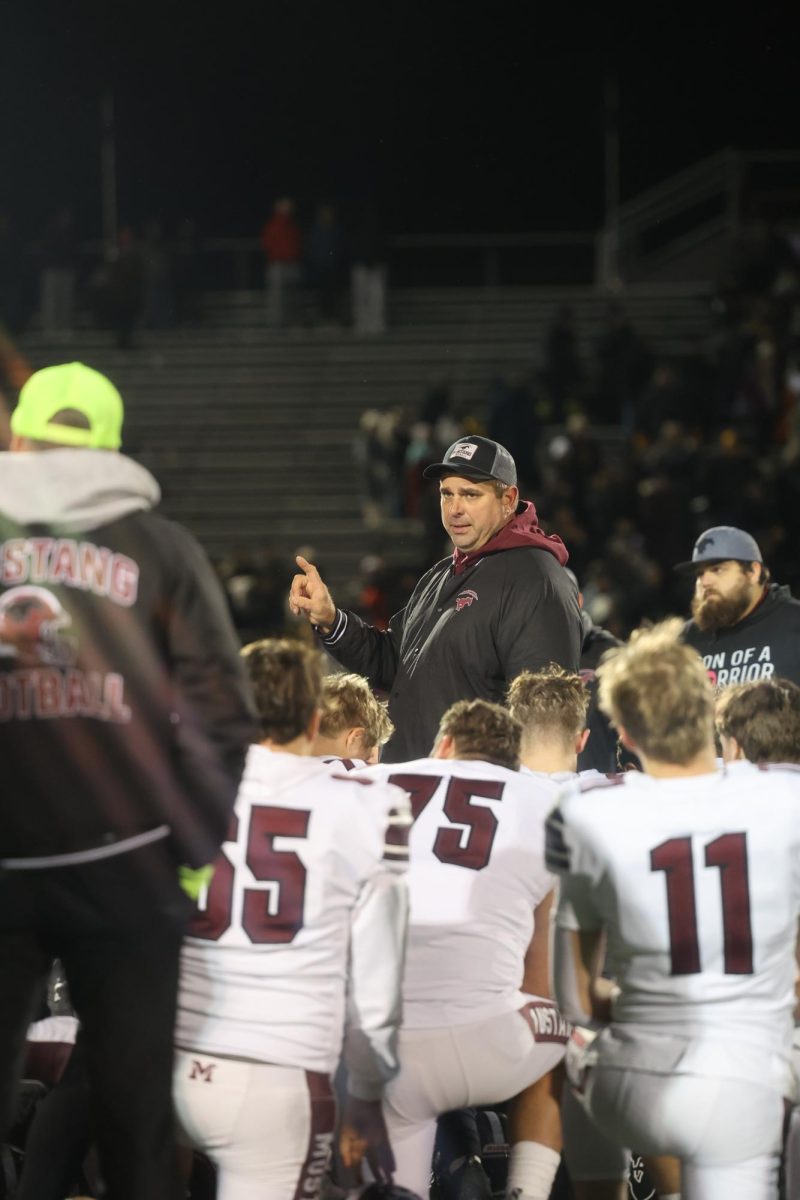
Outside the classroom, Timm also spent time coaching, including helping lead the state championship basketball team in 2012. That experience stands out as one of his most meaningful memories, especially for a personal reason. “My son was on the team,” Timm said. “That made it a lot more special.” Coaching allowed him to connect with students in a different way, building relationships beyond academics.
Now, after decades of teaching and coaching, Timm is preparing to retire. His decision wasn’t because he stopped enjoying teaching, but because the timing felt right. “They offered a retirement package, so I’m being paid to retire,” Timm said. “But really, it’s just the right time.” Even with that decision, he says he still enjoys coming to school and meeting new students every year.
As he looks ahead, Timm isn’t focused on big plans or specific goals. Instead, he’s choosing to slow down and see what comes next. “I’m going to babysit my granddaughter on Fridays,” he said. “Other than that, I just want to have some space and figure out what I’m supposed to do next.” Unlike many people that retire, he doesn’t plan on picking up hobbies like golf or fishing. He expects to stay busy working with people, even if it’s not for money.
Timm’s wife, Stephanie Timm who works in the high school office, will retire a year later, even though they originally planned to do it together. “She’s happy and kind of jealous,” Timm said. “We wanted to retire at the same time, but that’s okay.” For now, Timm is focused on appreciating each day rather than reflecting too much on the past. “I haven’t spent a lot of time looking backwards,” Timm said. “I just try to enjoy every day.”
As the school begins the process of hiring someone new, Timm hopes the next teacher will continue building connections with students and helping them grow. “Hopefully they’ll do a better job than I did,” Timm said. But after 40 years of teaching, it’s clear the impact Timm had on students will be hard to replace.
In the end, Timm keeps his perspective simple. Even with all the changes in education, the goal has stayed the same. “Teachers want students to learn and work hard, and students don’t always want to do that,” Timm said. “That’s the game.” And for four decades, it’s a game that Timm has been proud to play—and one his students will remember him for long after the final bell rings.